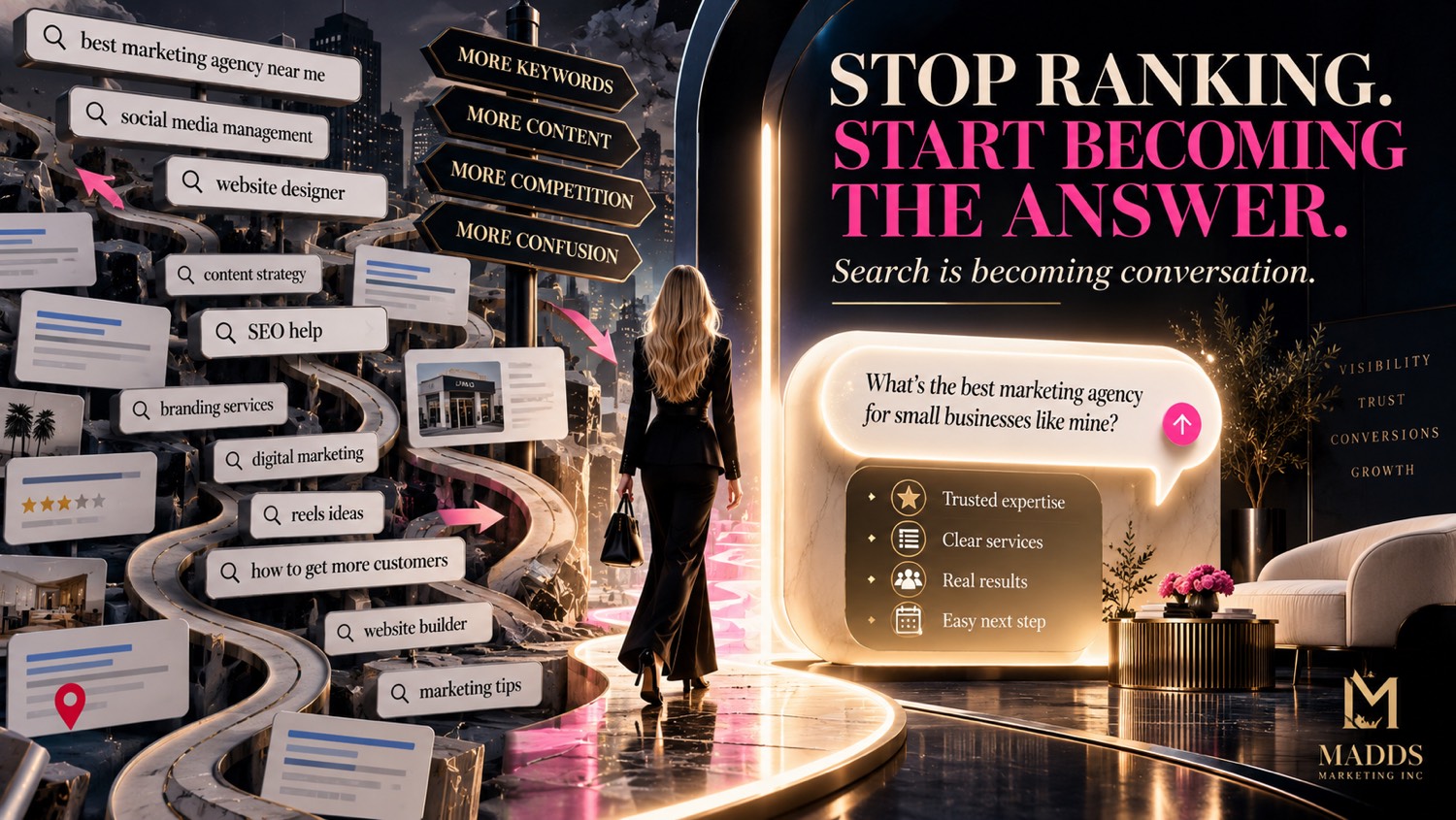
Your customer isn’t searching anymore. They’re asking.
How can you become the answer?
By Madison Fine, founder of MADDS Marketing · October 18, 2026
For twenty years, marketing trained businesses to think in keywords.
Plumber near me.
Best facial in Las Vegas.
Affordable accountant.
Marketing agency for small businesses.
We learned how to rank for those phrases, buy ads against them, build landing pages around them, and obsess over where we appeared on a results page.
But search is changing.
People are increasingly typing things that sound less like keywords and more like conversations:
“Who can help me fix my website without making me rebuild the whole thing?”
“What’s the best option for a small business that doesn’t have a huge marketing budget?”
“Which local company looks trustworthy and has experience with businesses like mine?”
That change looks small.
Psychologically, it’s enormous.
We’re moving from information retrieval to decision outsourcing
Traditional search gave us options.
AI search increasingly gives us answers.
That means your potential customer may not visit ten websites anymore.
They may ask one complicated question and let an AI system narrow the field for them.
Google says AI Mode has already passed one billion monthly users globally, and people using it are asking longer, more complex questions than they traditionally asked Search.
That changes what visibility means.
Being somewhere on page one isn’t necessarily enough.
Your brand now needs to be understandable enough to be recommended.
AI doesn’t “get the vibe” the way your best customer does
A customer may look at your Instagram and think:
I like her.
They may see your restaurant photos and immediately understand the atmosphere.
They may read three reviews and decide they trust you.
AI systems have to assemble that same conclusion from signals.
- Who are you?
- What exactly do you sell?
- Where are you located?
- Who do you serve?
- What are you known for?
- Do other credible sources mention you?
- Do your reviews consistently describe the same strengths?
- Does your website clearly explain your services?
- Is your information consistent across the internet?
The more ambiguous your business is online, the harder you are to confidently recommend.
This is where branding and search strategy are starting to collide.
The new goal isn’t just ranking. It’s becoming the obvious answer.
That requires something marketers have occasionally treated like an optional accessory:
clarity.
If your homepage says:
Empowering transformational solutions for tomorrow’s possibilities.
Congratulations.
Nobody knows what you do.
And now the machine probably doesn’t either.
Compare that with:
Bookkeeping for Las Vegas small businesses that need clean books, monthly reporting, and help staying tax-ready.
Less poetic.
Far more useful.
The second statement gives both humans and machines context.
And context is becoming currency.
This also changes advertising
Google is already experimenting with ads that appear inside conversational AI Search experiences instead of merely sitting above ten blue links. It has also been shifting more Search campaign functionality toward AI-powered systems like AI Max.
So the future ad may not simply answer:
“Did this business bid on the keyword?”
It may increasingly involve:
“Is this business relevant to this person’s entire situation?”
That is a much higher bar.
And potentially a much better opportunity for small businesses with a genuinely strong offer.
Because context can matter more than who stuffed the exact keyword into a page seventeen times.
What should small businesses do now?
Don’t panic and rename SEO to some shiny new acronym by tomorrow morning.
Instead, make your business easier to understand everywhere.
- Your website should clearly explain what you do.
- Your service pages should answer the questions real customers ask.
- Your Google Business Profile should be complete.
- Your reviews should contain actual details about the experience.
- Your content should demonstrate expertise instead of merely announcing that you exist.
- And your brand should tell the same story across your website, social profiles, directories, press mentions, and other places where people encounter you.
Because whether the customer finds you through Google, TikTok, Reddit, ChatGPT, Maps, or whatever search box shows up next, the underlying challenge is becoming remarkably similar:
Can the internet confidently understand who you are and why someone should choose you?
For years, businesses fought for clicks.
The next fight may be for recommendation.
And that changes the question marketers should be asking.
Not:
“How do I get to the top of search?”
But:
“How do I become the answer?”
If your site and your profiles don’t say what you sell, start there. I’ll name three specific misses in a free visibility audit. If you already know the presence is the problem, Business Launch is the build and Growth Management is what keeps it moving.
MADDS Marketing Inc.
Plan. Create. Grow.
First published on Substack.