

What a small business website actually costs here.
By Madison Fine, founder of MADDS Marketing · October 20, 2026

Most small business websites land somewhere between a few hundred dollars a year, if you build it yourself, and a few thousand up front if someone else builds it. Then there’s a smaller yearly cost to keep the thing alive. Where you land depends on who does the work, how many pages you need, and how much of the upkeep you want off your plate.
Published ranges are all over the map. That’s useless when you’re trying to decide. Here’s what each route actually costs, what the quotes leave out, and what I charge when the job is mine.
The short version
- A DIY builder, Wix or Squarespace, runs roughly $192 to $600 a year. You do all the work.
- A freelancer commonly charges $1,500 to $10,000, depending on the scope. A boutique agency build often starts around $5,000 and can run much higher.
- Upkeep is not optional. Security, plugin updates, and content refreshes can add $600 to $3,000 a year on a more complicated site.
- Ask for the list in writing. Pages, revisions, who writes the words, and what happens after launch. That’s the protection against a surprise invoice.
Three ways to pay
Every price you see online comes back to one choice: who does the work. The gap is time, skill, and who is responsible when it breaks.
| Route | What people publish | Who does it | Fits when |
|---|---|---|---|
| DIY builder | $200 to $2,500 up front, then $15 to $60 a month | You | Tight budget, and you have the nights |
| Freelancer | $1,500 to $10,000 | One person | A defined job with a clear brief |
| Agency | $5,000 to $35,000 and up | A team | A large or complicated site |
Those ranges come from published guides, and the guides don’t even agree. One puts a freelance designer at $500 to $5,000. Another puts a custom small-business site at $1,500 to $4,000. Treat a single number as a rumor. The overlap is the realistic zone.
Doing it yourself
Builders fold hosting, the security certificate, and a template into one monthly plan. The cash outlay stays low. The real cost is your time. Picking a template, writing every page, sizing photos, setting up the form, and checking it on a phone can eat weeks of evenings. If you like that work, DIY is a fine start. If every hour on the site is an hour you’re not serving a customer, the math changes.
Hiring one person
A freelancer gives you one person and a site shaped around the business, not a template with a logo dropped on it. The range is wide because the people are wide, from someone new building a simple page to someone building something custom.
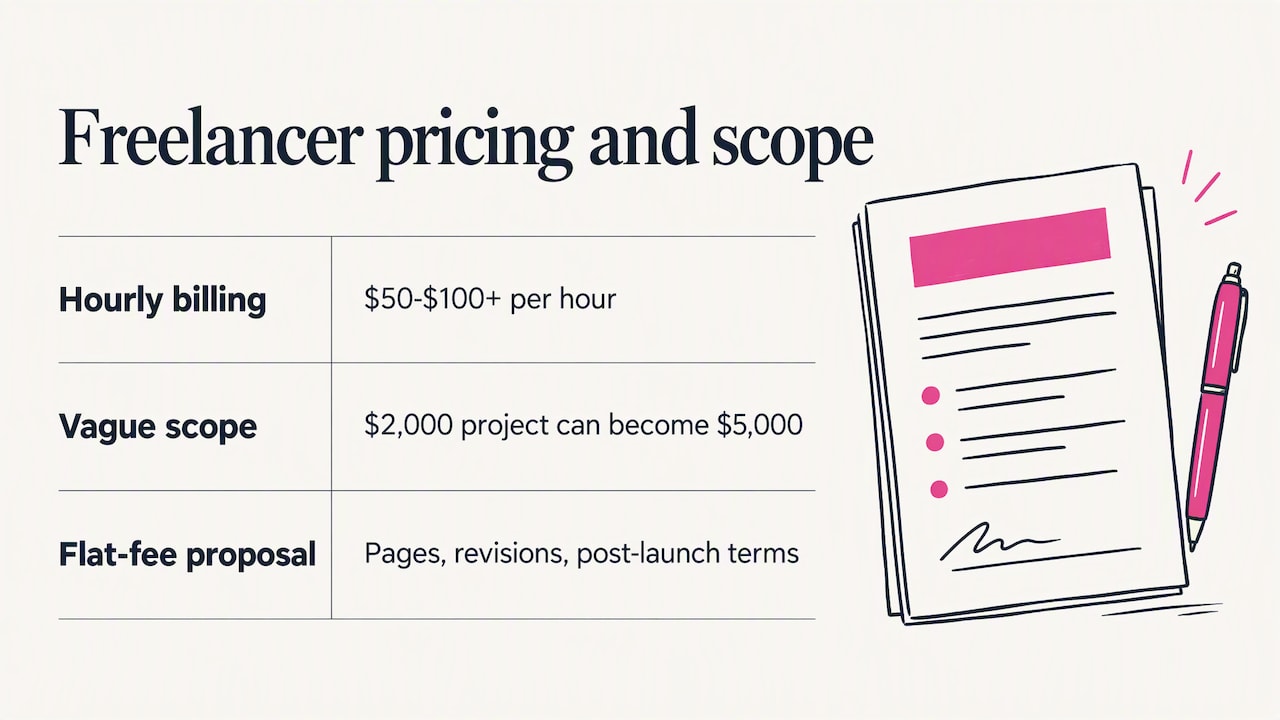
The trap is a vague scope. Hourly billing of $50 to $100 or more can turn a $2,000 job into a $5,000 one if nobody wrote down what’s included. A flat fee that lists the pages, the revisions, and what happens after launch keeps both sides honest.
Hiring an agency
An agency puts strategy, design, copy, and the build in one place. For a five-page local site, that is often more than you need. It makes sense when the site has to connect to a brand, tracking, ads, and ongoing content, or when the build is large, custom, or a shop.
You’ll see agency numbers stretch to $35,000. That number is real for those jobs. It is not what most local service businesses, restaurants, salons, or consultants need to spend to look like themselves and get found.
What actually moves the price
Two people can both say “I need a website” and hear $800 and $8,000. This is the gap.
- Pages. Home, about, services, contact, and one page per offer is a different job from thirty pages and a blog.
- Template or custom. A template is faster. A design from scratch takes more hours.
- Words and photos. Many quotes assume you supply both. If you don’t, someone has to write and find them.
- Features. Booking, payments, memberships, and a product catalog add time. A contact form does not.
- The brand. No logo, no colors, no sentence, and the site inherits whatever the builder picks, or someone designs the identity first.
- The phone. Most people arrive on one. A site that fails there costs you the lead, whatever you paid to build it.
- The connections. Google, analytics, email, scheduling. Each one is setup, not magic.
The costs left out of the headline
The build is a one-time number. The rest repeats. This is where people get burned.
A domain is usually $10 to $20 a year. Hosting starts at a few dollars a month. Builders fold hosting and the certificate into the plan. A self-hosted site, WordPress or otherwise, bills those separately, and you should know who owns the accounts.
Software, plugins, and security patches don’t update themselves. One guide puts recurring upkeep at $600 to $3,000 a year. Another puts website management at roughly $30 to $1,500 a month, depending on the setup. A simple builder site sits at the low end. A heavily customized one does not.
The wrong platform costs twice. A complicated WordPress install, when a simple page would have done the job, can mean $500 to $2,000 in extra developer fees for configuration, lock-in, or a slow site. Use the simplest thing that does today’s job, with room to grow.
If you collect customer information, privacy law applies. The same guide notes California CCPA fines cited at $2,500 to $7,500 per incident, and that accessibility lawsuits keep rising. I’m not your lawyer. You do want a privacy policy, type people can read, and a form that works. If you sell in California or collect sensitive data, ask an attorney what applies to you.
A site nobody finds doesn’t earn its cost. Photos, fresh copy, a Google profile, and a way to count the leads are part of the budget even when they’re not in the build quote.
A realistic budget
For a service business, a contractor, a bookkeeper, a coach, a boutique, that needs a professional multi-page site, think in lines, not one number.
| Line | Lower | If someone else does it |
|---|---|---|
| The build | A builder, and your time | One person or a small studio, fixed scope |
| Domain and hosting | Inside the builder plan | Billed yearly or monthly |
| Logo and colors | Whatever the template picks | Designed on purpose |
| You set it up | Set up, with a review link and lead tracking | |
| After launch | You make the edits | A monthly plan, if you want one |
“Is $1,500 a good price?” depends on the list behind it. For a small site with a clear brief, it can be fair. If the job also needs the words, the photos, a logo, and a booking system, $1,500 may be half the work. Don’t judge the number. Judge the deliverables. “From” pricing is how the rest of the bill hides.
How to read a quote
- How many pages, and how many rounds of changes?
- Who writes the copy, and who finds the images? If it’s you, when are they due?
- Who pays for hosting, the domain, and security? Who owns the accounts? What renews?
- Is the phone version and the lead form included, or billed as extras?
- When does it launch? A date beats “a few weeks.”
- What does a change cost in month two?
- Do you own the domain, the words, and the files when it’s over?
If a proposal can’t answer those in plain language, that’s how the project will go.
What I see, and what I charge
The website is rarely the actual problem. Someone lands and can’t tell, in a few seconds, what you do, why you, and how to hire you. A pretty page with no next step sits quiet. A page that matches the voice, works on a phone, and connects to a Google profile people can actually use is a page that works.
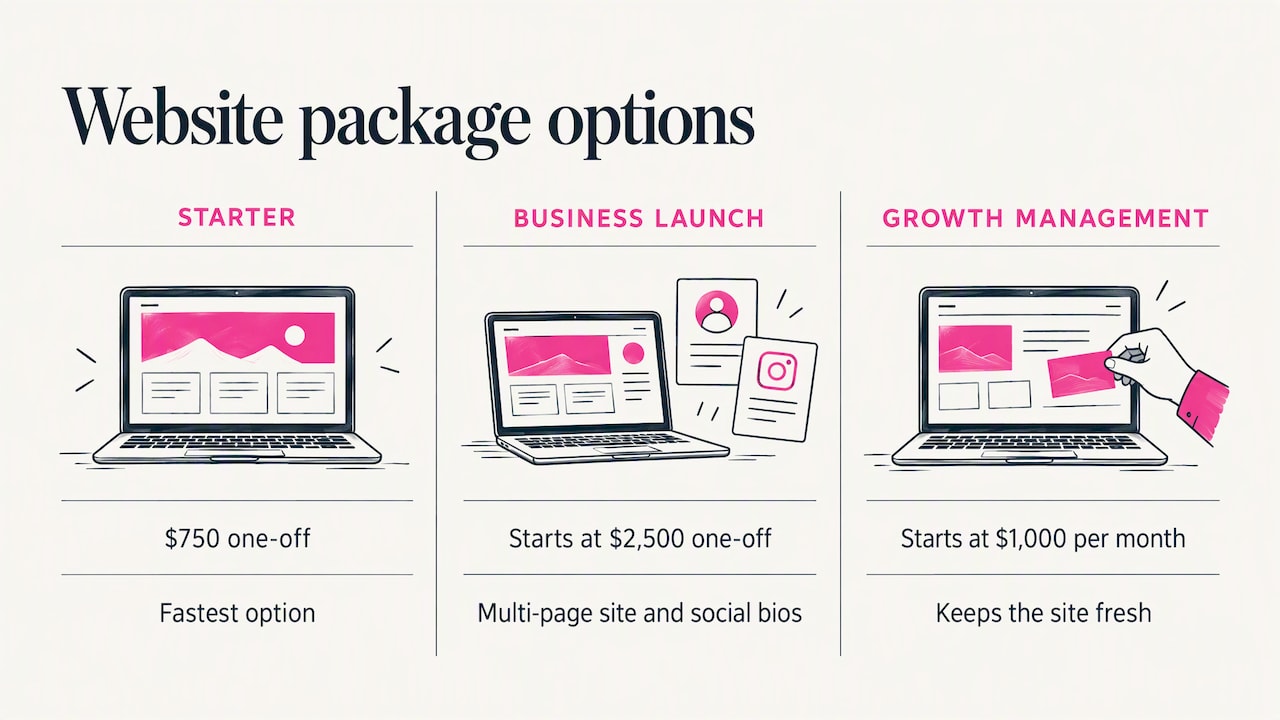
My prices are fixed and published. A one-page site, what you sell, proof, and a contact form, is the Website Starter at $750. Business Launch starts at $2,500. Up to five pages, the words written, a lead form, Google and two bios, and six posts for the week you go live. The clock of 7 to 10 business days starts when the photos, logins, and answers are in. Not when you pay. The logo is not included. Ads are not included. Photography is not included.
If you need the mark first, Brand In A Day is $497. One logo, the sentence, one page of rules, three bios, and five posts. Not a website. Google Setup starts at $750 for one location. If you want the site kept current after that, Growth Management starts at $1,500 a month: twelve posts you approve, one promo, the review message, and up to two small edits. A rebuild hiding inside “maintenance” gets priced as a rebuild.
You don’t need a $30,000 invoice to look like you meant it. You need the right amount for where the business is, and a list you can read before you pay. The full menu is on services. The work is on the portfolio. If you want the wider budget, I wrote what a small business should spend on marketing, and the difference between one person and a studio is in agency versus freelancer.
When to do it yourself
DIY is the right call if the offer is still unproven, you enjoy the work and have the hours, or the site only needs to be one simple page.
Hire someone if your time is worth more than the build, you want the site and the profiles to look like one business, you already have a site that doesn’t bring calls or forms, or you’d rather spend the week on customers.
How to set your number
- Write what the site must do. Calls, bookings, proof, a lead. One or two jobs, not ten.
- List the pages. Home, about, services, contact. Add a page only if it helps someone decide.
- Decide what you’ll supply. Photos, copy, and a logo either exist or they’re in the budget.
- Add what renews. Domain, hosting, and whoever makes the edits.
- Pick the route. You, if time is cheap. A fixed scope, if it isn’t.
- Get the quote in writing. Deliverables, revisions, and a date.
Then compare what you’re getting, not just what you’re paying. If you already know which of mine you need, tell me what you sell. One page or five is usually obvious from that. I’ll also tell you if the smaller one is enough.
Questions I get
How much should I pay?
A builder is a few hundred dollars a year. A professional build for most small businesses starts in the low thousands. Pay for a clear scope and a way for a customer to reach you. Don’t pay for the biggest number on the page.
Is $1,500 a good price?
It can be, if the list is clear. That’s the low end of a lot of freelancer ranges, so it’s normal for a small, simple site. Check that it includes the phone version, the words, the hosting setup, and at least one round of changes.
What does it cost after launch?
A domain renewal, hosting or a builder plan, security and updates, and someone refreshing the content. A simple DIY site stays cheap. A customized one can need several hundred to a few thousand dollars a year. Ask what is included after the site goes live, before you sign.
Do I need an LLC to have a website?
No. A website doesn’t require one. How the business is structured, and what you sell, is a question for an attorney or an accountant in your state. Not for the person building the page.
Sources
If this is the job, say so.
Tell me what’s missing. I’ll tell you which door it is before anyone starts.
Let’s Talk About Your Business