
People don’t buy when they’re confused.
By Madison Fine, founder of MADDS Marketing
There’s a psychological reason some marketing feels effortless and some feels like work.
Your brain is lazy.
Not stupid. Lazy.
It’s constantly trying to conserve energy, make fast judgments, and decide what deserves attention.
That means when someone lands on your page, sees your offer, watches your Reel, or opens your website, they are not carefully studying everything you made.
They’re scanning.
They’re asking, usually without realizing it:
- What is this?
- Is this for me?
- Do I trust it?
- What am I supposed to do next?
If your marketing makes people work too hard to answer those questions, they leave.
Not because your business is bad.
Not because your offer is bad.
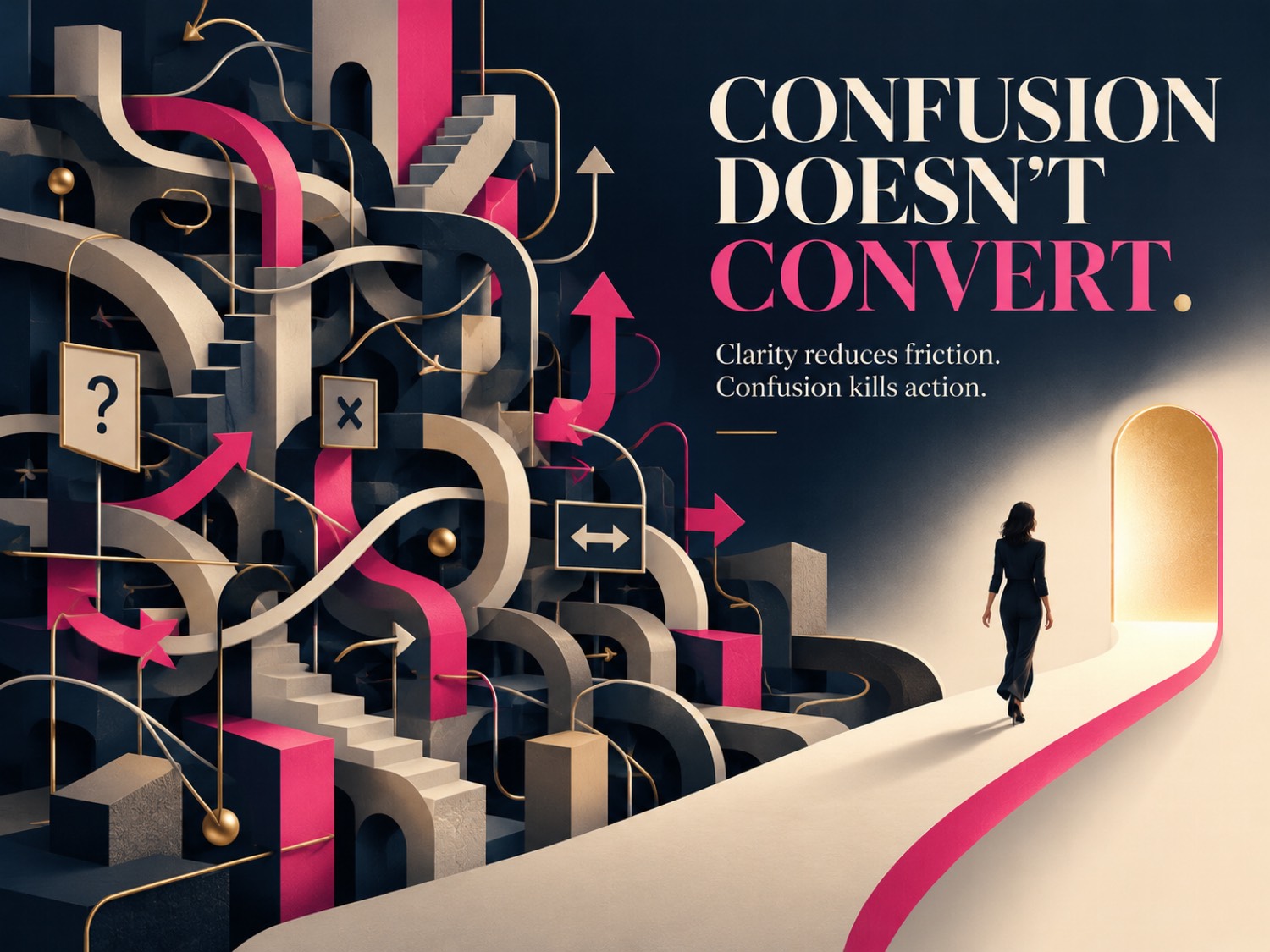
Because confusion creates friction.
And friction kills action.
One of the biggest mistakes small businesses make is assuming that more information creates more trust.
Sometimes it does.
But sometimes more information just creates more decisions.
More buttons.
More packages.
More paragraphs.
More choices.
More chances for someone to think:
I’ll come back later.
And “later” is where conversions go to die.
There’s a concept in psychology called cognitive load.
Basically, your brain can only process so much at once before it starts looking for an exit.
That matters in marketing because every extra decision you ask someone to make costs attention.
Three different calls to action.
Nine services on one page.
Five pricing tiers.
A vague headline.
A bio that tries to explain your entire life story.
None of those things are automatically bad.
But together?
Now your customer is doing homework.
And people do not open Instagram because they were hoping for homework.
Good marketing reduces decisions.
It gives the brain somewhere obvious to go.
- This is what we do.
- This is who it’s for.
- This is why it matters.
- This is what you do next.
That’s it.
Clarity feels good because certainty feels safe.
And safety matters more in buying decisions than most businesses realize.
People don’t just buy based on price.
They buy based on confidence.
Confidence that you understand the problem.
Confidence that you can solve it.
Confidence that they won’t regret choosing you.
That’s why a simple website with a clear offer can outperform a beautiful website that says absolutely nothing.
The same thing happens with content.
If I have to watch your Reel twice to understand what you’re talking about, the problem isn’t my attention span.
Your message wasn’t clear enough.
If your caption takes six paragraphs to explain what you sell, the problem isn’t that people “don’t read anymore.”
Your positioning needs work.
If someone visits your profile and still doesn’t know what you do?
That’s not a follower problem.
That’s a clarity problem.
There’s another psychological layer here too.
People tend to trust things they can process easily.
Simple messages feel more familiar.
Familiar things feel safer.
Safer things feel easier to choose.
That does not mean your brand should be boring.
It means your creativity should make the message easier to remember, not harder to understand.
Your branding can be loud.
Your personality can be weird.
Your content can be funny.
Your visuals can be dramatic.
But the actual message?
Crystal clear.
Before you change your logo, run another ad, or decide social media “isn’t working,” look at your marketing through one question:
Am I making this easy to understand?
Not impressive.
Not clever.
Not trendy.
Easy.
Because the customer who understands you is a lot closer to becoming the customer who chooses you.
And sometimes the smartest marketing move isn’t adding anything.
It’s removing everything standing between the customer and the decision.
MADDS Marketing Inc.
Plan. Create. Grow.
If your marketing feels busy but still isn’t converting, start with clarity. I offer free visibility audits that show you where people may be getting lost.